
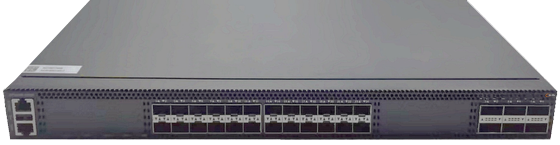
AP-DC10G24X6Q
100 Gigabit Ethernet uplinks
- 24 x 10G SFP+ and 6 x 100G QSFP28
- 1+1 power supplies (AC), 3+1 fans
- 1 console, 1 USB, 1 RJ45 management ports
- Forwarding performance: 600Mpps
- Switching capacity: 1.68Tbps
Product Overview
The AirPro DC Series is a family of high-performance, stackable Layer 3 switches designed for scalable enterprise, campus, and data center networks. High-density fiber connectivity and integrated 100 Gigabit Ethernet uplinks deliver the bandwidth and forwarding performance required for demanding aggregation and core deployments.
Built on an advanced hardware and software architecture, the DC Series incorporates modular 1+1 redundant AC power supplies, a 3+1 redundant fan design, and configurable airflow direction to enhance service availability and simplify deployment in diverse rack environments.
Comprehensive data center capabilities—including VXLAN, EVPN, M-LAG, NETCONF, and streaming telemetry—support network virtualization, resilient fabric architectures, automation, and real-time operational visibility. These capabilities make the DC Series well suited for high-density aggregation in enterprise and campus networks, as well as next-generation data centers requiring 10GbE server access and 100GbE fabric aggregation.
Key Features
High-Performance, Scalable Architecture
The AirPro DC Series delivers high switching capacity and wire-speed Layer 2 and Layer 3 forwarding for demanding enterprise, campus, and data center environments. Hardware-based IPv4 and IPv6 processing provides consistent routing performance while supporting the growth of applications, users, and connected devices.
Flexible 10 Gigabit Ethernet connectivity is provided through hot-swappable SFP+ transceivers. Depending on the selected optical module and fiber type, link distances can extend up to 300 meters over multimode fiber and from 10 to 40 kilometers over single-mode fiber.
Resilient, High-Availability Design
The DC Series is engineered for continuous operation with a resilient hardware and software architecture. Modular 1+1 redundant power supplies and a 3+1 redundant fan design help maintain system availability during component failure or replacement.
Dual system software images provide an additional layer of operational protection. If the primary image becomes unavailable, the switch can start from the backup image, helping reduce recovery time and minimize service disruption.
Virtual Switch Framework
Virtual Switch Framework (VSF) enables multiple compatible AirPro switches to operate as a single logical system. VSF increases aggregate switching capacity and port density while providing a unified platform for configuration, monitoring, and administration.
By simplifying the management of multiple physical switches, VSF improves deployment flexibility, supports network expansion, and enhances resiliency across data center and enterprise environments.
Advanced Layer 3 Routing
The AirPro DC Series provides high-performance, hardware-based IP routing for complex and scalable network architectures.
Support for dynamic routing protocols—including RIP, OSPF, and BGP—enables efficient route exchange with Layer 3 switches and routers. Policy-Based Routing (PBR) provides granular control over forwarding decisions, making the platform well suited for multi-uplink, multi-exit, and application-aware routing deployments.
MPLS and VPLS Services
Support for MPLS Layer 3 VPN and MPLS Layer 2 VPN/VPLS enables organizations and service providers to build secure, scalable, and logically segmented networks.
The DC Series can be deployed in provider (P) and provider-edge (PE) roles, supporting traffic isolation, service separation, and a broad range of enterprise and carrier networking requirements.
Comprehensive IPv6 Capabilities
The DC Series supports hardware-based IPv6 switching and routing to deliver high performance across dual-stack and next-generation network environments.
Comprehensive IPv6 capabilities help organizations address expanding device populations, larger addressing requirements, and evolving security needs while providing a structured migration path from IPv4 to IPv6.
Selected models and software releases may support IPv6 Forum Phase II certification. Certification status should be verified for the applicable platform and software version before publication.
Comprehensive Multicast Services
The AirPro DC Series provides extensive Layer 2 and Layer 3 multicast capabilities for efficient delivery of video, collaboration, financial data, and other bandwidth-intensive services.
Layer 2 multicast features include IGMPv1/v2/v3 snooping and fast-leave processing. Layer 3 multicast support includes IGMPv1/v2/v3, PIM-DM, PIM-SM, PIM-SSM, and MSDP.
Additional capabilities—including Multicast VLAN Registration (MVR), multicast source and receiver controls, and unauthorized multicast-source detection—help optimize bandwidth utilization, strengthen traffic control, and improve multicast service reliability.
*Feature availability may vary by switch model, software release, license, optical transceiver, and network configuration.
Hardware Specifications
| 10GbE ports | 24 × SFP+ |
| 100GbE uplink ports | 6 × QSFP28 |
| Switching capacity | 1.68 Tbps |
| Forwarding performance | 600 Mpps |
| MAC address table | 32K entries |
| ARP table | 8K entries |
| Routing table | 30K entries |
| Dimensions (W × D × H) | 442.5 × 473 × 43.95 mm |
| Operating temperature | 0°C to 45°C |
| Storage temperature | –40°C to 70°C |
| Relative humidity | 5% to 95%, non-condensing |
| AC input | 100–240 VAC, 50/60 Hz |
| Power-supply architecture | 1+1 modular redundant AC |
Management Interfaces
| Console | 1 × RJ-45 console port |
| Out-of-band management | 1 × 100/1000BASE-T RJ-45 Ethernet management port |
| USB | 1 × USB management port |
Layer 2 Switching
| Jumbo frames | Up to 10K bytes |
| Link diagnostics | Port loopback detection and Unidirectional Link Detection |
| Neighbor discovery | LLDP and LLDP-MED |
| Link aggregation | IEEE 802.3ad LACP with support for up to 127 link aggregation groups |
| Load distribution | Configurable LACP load balancing |
| Traffic mirroring | N:1 port mirroring, RSPAN, and ERSPAN |
| Spanning Tree protocols | IEEE 802.1D STP, IEEE 802.1w RSTP, and IEEE 802.1s MSTP |
| Spanning Tree protection | Root Guard, BPDU Guard, and BPDU Tunnel |
| Ring protection | Ethernet Ring Protection Switching, ITU-T G.8032 |
| VLAN scalability | IEEE 802.1Q with support for up to 4,096 VLANs |
| Advanced VLAN services | MAC-based VLAN, voice VLAN, private VLAN, protocol-based VLAN, and multicast VLAN |
| VLAN tunneling | Q-in-Q and flexible Q-in-Q |
| Dynamic VLAN registration | GVRP |
| VLAN translation | N:1 VLAN translation |
| Storm control | Broadcast, multicast, and unknown-unicast storm control |
| IPv4 multicast snooping | IGMPv1/v2/v3 snooping and Layer 2 IGMP querier |
| IPv6 multicast snooping | MLDv1/v2 snooping |
| IPv6 neighbor protection | Neighbor Discovery snooping |
| Access-port security | Port security |
| Flow and bandwidth control | HOL control, IEEE 802.3x flow control, and bandwidth control |
Layer 3 Routing
| Static routing | IPv4 and IPv6 static routing |
| IPv4 routing protocols | RIPv1/v2, OSPFv2, and BGP-4 |
| IPv6 routing protocols | RIPng, OSPFv3, and BGP4+ |
| OSPF scalability | Multiple OSPF processes |
| Route lookup | Longest Prefix Match routing |
| Policy-Based Routing | PBR for IPv4 and IPv6 |
| Gateway redundancy | VRRP and VRRPv3 |
| Source validation | uRPF for IPv4 and IPv6 |
| Multipath forwarding | ECMP |
| Fast failure detection | BFD |
| DNS services | DNS client and DNSv6 |
| Tunneling | GRE, 6to4, configured, and ISATAP tunnels |
Multicast Routing
| IPv4 multicast membership | IGMPv1/v2/v3 and IGMP Proxy |
| IPv4 multicast routing | DVMRP, PIM-DM, PIM-SM, and PIM-SSM |
| IPv6 multicast routing | PIM-DM and PIM-SM for IPv6 |
| Rendezvous Point resiliency | Anycast RP for IPv4 and IPv6 |
| Interdomain multicast | MSDP |
| Static multicast routing | Static multicast routes |
| Multicast control | Multicast receiver control |
| Multicast security | Unauthorized multicast-source detection |
| IPv6 multicast membership | MLDv1/v2 |
| Multicast VLAN services | IPv4 and IPv6 multicast VLAN support |
IPv6 Services
| Core IPv6 protocols | ICMPv6, Neighbor Discovery, Router Advertisement, and DNSv6 |
| IPv6 forwarding | IPv6 Longest Prefix Match routing |
| IPv6 traffic engineering | IPv6 Policy-Based Routing |
| IPv6 redundancy | VRRPv3 |
| IPv6 source validation | IPv6 uRPF |
| IPv6 dynamic routing | RIPng, OSPFv3, and BGP4+ |
| IPv6 multicast | MLDv1/v2, MLD snooping, PIM-SM/DM, Anycast RP, and multicast VLAN |
| IPv6 security and QoS | IPv6 ACL and IPv6 QoS |
| Transition mechanisms | 6to4, configured, ISATAP, and GRE tunnels |
MPLS and VPN Services
| MPLS foundation | MPLS, VRF, and LDP |
| Layer 3 VPN | MPLS Layer 3 VPN |
| Layer 2 VPN | MPLS Layer 2 VPN / VPLS |
| Point-to-point VPN | VPWS |
Quality of Service
| Hardware queues | Eight queues per port |
| Queue scheduling | SP, WDRR, and combined SP+WDRR |
| Traffic classification | IEEE 802.1p CoS, ToS, DiffServ DSCP, ACL, and TCP/UDP port number |
| Bandwidth management | Traffic shaping |
| Priority handling | Priority marking and remarking |
Access Control Lists
| ACL types | IP ACL, MAC ACL, and combined IP-MAC ACL |
| Matching criteria | Source/destination IP or MAC address, IP protocol, TCP/UDP port, DSCP, ToS, IP precedence, VLAN, tagged/untagged state, and CoS |
| ACL actions | Permit, deny, redirect, and traffic accounting |
| Application points | Physical ports and VLANs |
| Scheduled policies | Time-range ACLs |
Security and Authentication
| Network access control | IEEE 802.1X AAA |
| Authentication methods | Port-based authentication, MAC-based authentication, and MAB |
| Centralized authentication | RADIUS and TACACS+ over IPv4 and IPv6 |
| Dynamic access assignment | Guest VLAN and automatic VLAN assignment |
| Accounting | Session accounting based on duration and traffic volume |
| ARP protection | ARP Guard, ARP binding, ARP limiting, gratuitous ARP, Proxy ARP, and local Proxy ARP |
| Threat protection | Anti-ARP spoofing and anti-ARP scanning |
DHCP Services
| DHCP server/client | DHCP server and client for IPv4 and IPv6 |
| DHCP relay | DHCP relay for IPv4 and IPv6 |
| DHCP Option 82 | Option 82 insertion and processing |
| DHCP security | DHCP snooping and Option 82 validation |
Management, Monitoring, and Operations
| Management interfaces | CLI, web-based management, and Telnet |
| Secure management | SSH v1/v2 and HTTPS |
| Network management | SNMPv1, SNMPv2c, and SNMPv3 over IPv4 and IPv6 |
| Event management | Syslog and external Syslog server |
| Monitoring and notifications | SNMP MIBs and SNMP traps |
| Traffic visibility | sFlow traffic analysis and telemetry |
| File transfer | FTP and TFTP |
| Time synchronization | SNTP and NTP |
| Remote monitoring | RMON groups 1, 2, 3, and 9 |
| Administrator authentication | RADIUS-based management authentication |
| Software resiliency | Dual firmware images and dual configuration files |
| Ethernet OAM | IEEE 802.3ah Ethernet Link OAM and IEEE 802.1ag Connectivity Fault Management |
Data Center and Fabric Features
| Network virtualization | VXLAN |
| Multi-chassis resiliency | MLAG |
| Network automation | NETCONF |
| Operational visibility | Telemetry |
| Switch virtualization | Virtual Switch Framework |
| Mixed-model VSF | Supports mixed stacking between AP-DC10G24X6Q and AP-DC10G48X6Q |
Positioning Summary
The AP-DC10G24X6Q and AP-DC10G48X6Q combine high-density 10GbE access connectivity with six 100GbE uplinks, advanced Layer 3 routing, MPLS services, VXLAN, MLAG, and VSF virtualization. The platforms are well suited for data center top-of-rack and aggregation deployments, as well as high-performance enterprise and campus aggregation environments requiring resilient 10G/100G connectivity.
*Feature availability may vary by software release, license, transceiver, and deployment configuration.
Order Information
| Product | Description |
| AP-DC10G24X6Q | 100G Advance Enhanced Datacenter Switch (24*10GbE(SFP+)+6*100GbE(QSFP28)) , Redundant and modular Design, High performance. Full L3 features, Default with two hot-swap AC power supply, Default with 4(3+1) fans |
| AP-DC10G48X6Q | 100G Advance Enhanced Datacenter Switch (48*10GbE(SFP+)+6*100GbE(QSFP28)) , Redundant and modular Design, High performance. Full L3 features, Default with two hot-swap AC power supply, Default with 4(3+1) fans |
Compare Product
| Specification | AP-DC10G24X6Q | AP-DC10G48X6Q |
| 10GbE ports | 24 × SFP+ | 48 × SFP+ |
| 100GbE uplink ports | 6 × QSFP28 | 6 × QSFP28 |
| Switching capacity | 1.68 Tbps | 2.16 Tbps |
| Forwarding performance | 600 Mpps | 600 Mpps |
| MAC address table | 32K entries | 32K entries |
| ARP table | 8K entries | 8K entries |
| Routing table | 30K entries | 30K entries |
| Dimensions (W × D × H) | 442.5 × 473 × 43.95 mm | 442.5 × 473 × 43.95 mm |
| Operating temperature | 0°C to 45°C | 0°C to 45°C |
| Storage temperature | –40°C to 70°C | –40°C to 70°C |
| Relative humidity | 5% to 95%, non-condensing | 5% to 95%, non-condensing |
| AC input | 100–240 VAC, 50/60 Hz | 100–240 VAC, 50/60 Hz |
| Power-supply architecture | 1+1 modular redundant AC | 1+1 modular redundant AC |