
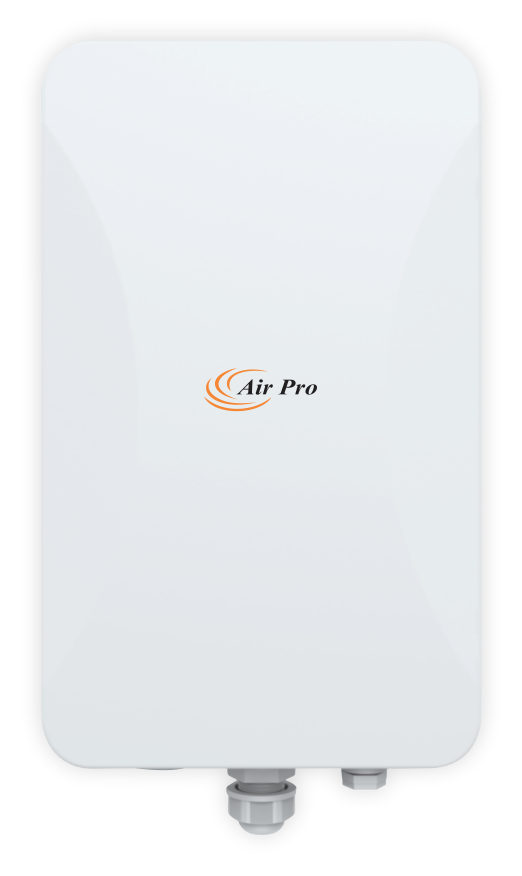
AIR-AP690IX(V2)
Extended Reach. High-Speed Connectivity.
- High-level outdoor 802.1ax wireless access
- Uplink Connection
- Operating in a normal outdoor temperature range
- IP66 Anti-dust & water standard
- Good PoE compatibility
Product Overview
The AIR-AP690IX(V2) is a high-performance outdoor wireless access point that supports both 2.4 GHz and 5 GHz frequency bands. It leverages advanced technologies such as Multi-User Multiple-Input Multiple-Output (MU-MIMO) and Orthogonal Frequency Division Multiplexing (OFDM) to deliver robust wireless performance. The device supports data transmission rates of up to 575 Mbps on the 2.4 GHz band and 2400 Mbps on the 5 GHz band, accommodating up to 254 concurrent users. With a built-in omnidirectional antenna, the AIR-AP690IX(V2) is ideal for wide-area outdoor Wi-Fi coverage in various network environments.
Key Features
High-level outdoor 802.1ax wireless access
The AIR-AP690IX(V2) supports the 802.11ax standard and can operate in 2.4 GHz and 5 GHz both bands. It provides an access bandwidth up to 2975 Mbps, which can connect users up to 254 simultaneously.
Uplink Connection
The 2.5G WAN PoE port is used as the uplink interface, effectively overcoming traditional bandwidth limitations and ensuring high-speed data transmission.
Operating in a normal outdoor temperature range
Thanks to deliberate hardware design and the selection of dedicated components it can operate in a temperature range from -25°C to 55°C.
IP66 Anti-dust & water standard
It comply IP66 can be deployed in the harshest outdoor environment.
Good PoE compatibility
AIR-AP690IX(V2) can work well with the third-part PoE switches that support 802.3at standard.
High-performance RF
The professional optimized design is employed for the RF module, integrated directional antenna supports 26 dB transmission power which can greatly improve wireless coverage.
Cloud management
It can operate with the cloud platform seamlessly to provide a better cost-performance solution;
Multi-mode: fit, fat, bridge
It can work in fit, fat or bridge mode and can flexibly switch between these three modes according to network planning requirements.
Hardware Specifications
| Dimensions (L*W*D) (mm) | 304×181×88 |
| Working Frequency | 2.4G:802.11b/g/n/ax 5G:802.11a/n/ac/ax |
| Maximum Data Rate | 2.4G:575Mbps 5G:2400Mbps |
| Physical Port | 1 * 10/100/1000/2500M Base-T PoE port for uplink 1 * 10/100/1000Base-T downlink port |
| LED indicator | Yes |
| Mounting mode | Pole-mounting |
| PoE | 802.3at |
| Maximum power consumption | < 19W |
| Antenna type | Internal Omni directional antenna |
| Antenna gain | 2.4G 5dBi, 5G 6dBi |
| Transmit power | 2.4G: 26dBm (Per Chain) 5G : 25dBm (Per Chain) |
| Transmit power adjustment granularity | 1 dBm |
| Working frequency band | 802.11b/g/n/ax: 2.4 GHz to 2.483 GHz 802.11a/n/ac/ac wave 2/ax: 5.150~5.350GHz 5.47~5.725GHz 5.725~5.850GHz |
| Modulation technology | 11b:DSS: CCK@5.5/11Mbps, DQPSK@2Mbps, DBPSK@1Mbps 11a/g:OFDM:64QAM@48/54Mbps,16QAM@24Mbps, QPSK@12/18Mbps, BPSK@6/9Mbps 11n:MIMO-OFDM: BPSK, QPSK,16QAM,64QAM 11ac:MIMO-OFDM: BPSK, QPSK,16QAM,64QAM,256QAM 11ax: MIMO-OFDMA: BPSK, QPSK,16QAM,64QAM,256QAM,1024QAM |
| Working/Storage temperature | -25°C to +55°C
–40°C to +70°C |
| Working/Storage RH | 5% to 95% (non-condensing) |
| Protection level | IP66 |
Software Specifications
| WLAN | Product positioning | Outdoor dual frequency |
| Working frequency band | 2.4 GHz and 5 GHz | |
| Bandwidth performance | 2975Mbps | |
| Virtual AP (BSSID) | 32 | |
| Concurrent user | 254 | |
| Number of spatial streams | 2.4G: 2 5G:4 | |
| Dynamic channel adjustment (DCA) | Yes | |
| Transmit power control (TPC) | Yes | |
| Blind area detection and repair | Yes | |
| SSID hiding | Yes | |
| RTS/CTS | Yes | |
| RF environment scanning | Yes | |
| Hybrid access | Yes | |
| Restriction on the number of access users | Yes | |
| Link integrity check | Yes | |
| Accessing control of terminals based on signal strength | Yes | |
| Forcing terminals to roam based on signal strength | Yes | |
| Intelligent control of terminals based on airtime fairness | Yes | |
| High-density application optimization | Yes | |
| 802.11ax | Space streams | 2.4GHz:2, 5GHz:4 |
| Frequency band | 2.4GHz + 5GHz | |
| 80 MHz bundling | Yes | |
| 1200Mbps(PHY) | Yes | |
| Frame aggregation (A-MPDU) | Yes | |
| Frame aggregation (A-MSDU) | Yes | |
| Maximum likelihood demodulation (MLD) | Yes | |
| Transmit beamforming (TxBF) | Yes | |
| Maximum ratio combining (MRC) | Yes | |
| Space-time block coding (STBC) | Yes | |
| Low-density parity-check code (LDPC) | Yes | |
| Security | Encryption | 64/128 WEP, WPA2/WPA3 PSK, WPA2/WPA3 Enterprise 802.1x, TKIP, and CCMP encryption |
| 802.11i | Yes | |
| Portal authentication | Yes | |
| WAPI | Yes | |
| MAC address authentication | Yes | |
| LDAP authentication | Yes | |
| PEAP authentication | Yes | |
| WIDS/WIPS | Yes | |
| Real time spectrum guard | Yes | |
| Protection against DoS attacks | Anti-DoS for wireless management packets | |
| Forwarding security | Frame filtering, white list, static blacklist, and dynamic blacklist | |
| User isolation | AP L2 forwarding suppression Isolation between client |
|
| Periodic SSID enabling and disabling | Yes | |
| Access control of free resources | Yes | |
| Wireless SAVI | Yes | |
| ACL | Access control of various data packets such as MAC, IPv4, and IPv6 packets | |
| Secure access control of APs | Secure access control of APs, such as MAC authentication, password authentication, or digital certificate authentication between an AP and an AC | |
| 802.11W | Yes, encryption of management frames | |
| Forwarding | IP address setting | Static IP address configuration or dynamic DHCP address allocation |
| IPv6 forwarding | Yes | |
| IPv6 portal | Yes | |
| Local forwarding | Yes | |
| Multicast | IGMP snooping | |
| Roaming | Yes | |
| AP switching reference | Signal strength, bit error rate, RSSI, S/N, whether neighboring APs are normally operating, etc. | |
| WDS | Yes | |
| QoS | WMM | Yes |
| Priority mapping | Ethernet port 802.1P identification and marking Mapping from wireless priorities to wired priorities |
|
| QoS policy mapping | Mapping of different SSIDs/VLANs to different QoS policies Mapping of data streams that match with different packet fields to different QoS policies |
|
| L2-L4 packet filtering and flow classification | Yes: MAC, IPv4, and IPv6 packets | |
| Load balancing | Load balancing based on the number of users Load balancing based on user traffic Load balancing based on frequency bands |
|
| Bandwidth limit | Bandwidth limit based on APs Bandwidth limit based on SSIDs Bandwidth limit based on terminals Bandwidth limit based on specific data streams |
|
| Call admission control (CAC) | CAC based on the number of users | |
| Power saving mode | Yes | |
| Automatic emergency mechanism of APs | Yes | |
| Intelligent identification of terminals | Yes | |
| Multicast enhancement | Multicast to unicast | |
| Management | Network management | Centralized management through an AC; both fit and fat modes |
| Mesh networking | Through central AP to manage the RE AP | |
| Maintenance mode | Both local and remote maintenance | |
| Log function | Local logs, Syslog, and log file export | |
| Alarm | Yes | |
| Fault detection | Yes | |
| Statistics | Yes | |
| Switching between the fat, fit and bridge modes | An AP working in fit mode can switch to the fat mode through a wireless AC; An AP working in fat mode can switch to the fit or bridge mode through a local control port or Telnet(web) An AP working in bridge mode can switch to the fit or fat mode through a local control port or Telnet(web) |
|
| Remote probe analysis | Yes | |
| Watchdog | Yes | |
| Value added service | Wi-Fi location | For Wi-Fi terminal and tag |
| Wi-Fi probe | Yes | |
| Value added marketing | Support: various apps based on intelligent terminals, advertising push based on location, personalized push of portals | |
| Value added authentication | SMS, QR code, Voucher, Email | |
| Passenger flow analysis | Yes |