
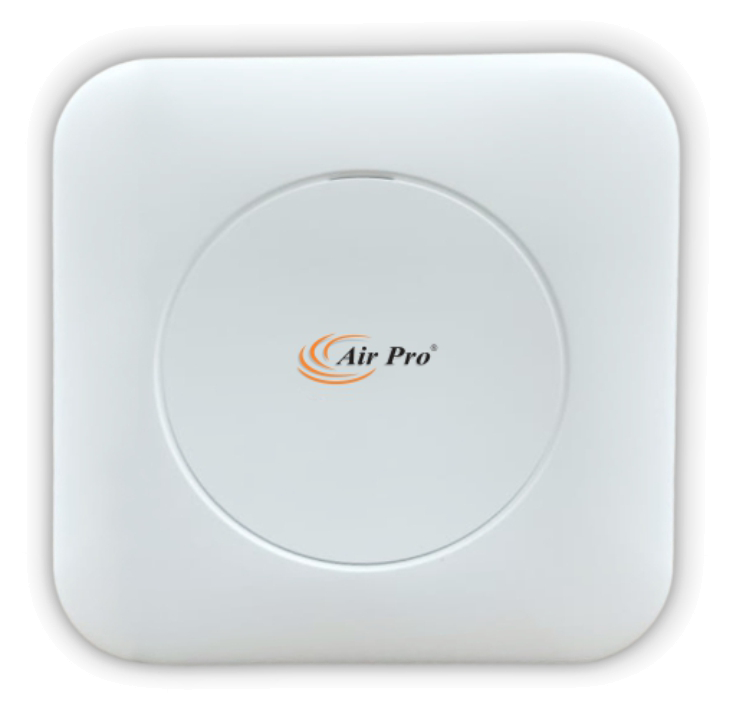
AIR-AP660C-BE
Wi-Fi 7 Dual-Band 2.5G AP – Ultra-Fast 3570 Mbps
- Enterprise-class indoor 802.11be Wi-Fi 7 wireless access point
- Wireless user management at a fine granularity
- Flexible installation
- Powered by PoE port or external power adapter
- Multi-mode: fit, fat, bridge
- AirMatch Technology
Product Overview
The AIR-AP660C-BE is a high-performance dual-band 2.5 Gigabit wireless access point designed by AirPro, built on the latest 802.11be (Wi-Fi 7) standard. It delivers a combined maximum wireless throughput of 3570 Mbps, providing exceptional network performance for high-density environments. Operating on both 2.4 GHz and 5 GHz frequency bands, the AP660C supports advanced wireless technologies such as 240 MHz Channel Bonding and 4096-QAM modulation, ensuring ultra-high-speed connectivity and enhanced capacity.
• Radio 1 (2.4 GHz):
– Maximum Access Rate: 688 Mbps
• Radio 2 (5 Ghz):
– Maximum Access Rate: 2882 Mbps
With its cutting-edge features and robust performance, the AIR-AP660C-BE is perfect for enterprise-grade wireless deployments, offering seamless connectivity, high bandwidth, and superior user experience.
Key Features
Enterprise-class indoor 802.11be Wi-Fi 7 wireless access point
AP660C-BE supports the 802.11be standard, operates in both 2.4 GHz and 5 GHz band, and provides an access bandwidth up to 3570 Mbps. This model is the best choice for middle-level office or company as it can support concurrent users up to 240.
Wireless user management at a fine granularity
AP660C-BE can support a maximum of 32 WLANs to implement multi-layer multi-service management of wireless users at a fine granularity. Each WLAN supports access control and uplink/ downlink rate limit based on MAC or IP addresses. These WLANs may be bound to virtual local area networks (VLANs).
Flexible installation
AP660C-BE supports wall mounting, ceiling mounting, T-keel mounting, you can deploy it almost everywhere you want.
Powered by PoE port or external power adapter
AP660C-BE can be powered by PoE port or external power adapter, input 100~240V AC, output: 48 V DC.
Multi-mode: fit, fat, bridge
AP660C-BE can work in fit, fat and Cloud mode and can flexibly switch between these three modes according to network planning requirements.
AirMatch Technology
AP660C-BE supports AirMatch technology, an advanced AirPro technology that enables continuous WLAN optimization through intelligent client steering, load balancing, seamless roaming, and real time network-wide monitoring – without requiring client-side
software.
Hardware Specifications
| Dimensions (L×W×D) (mm) | 210 × 210 × 41 |
| Memory | 512MB |
| Flash | 144MB |
| 1/2.5G BaseT port | 1 |
| 1/2.5G SFP port | 1 |
| USB 2.0 | 1 |
| Console port (RJ45) | 1 |
| BLE port | 1 |
| Indicator LED | Yes |
| Reset button | Yes |
| Power supply | 802.3af & at and External power adapter (Input: 100–240V AC, Output: 48V DC) |
| Maximum power consumption | <19.7W |
| RF port | Builtin 2.4 GHz 3 dBi antenna and 5 GHz 3 dBi antenna |
| Working frequency band | 802.11b/g/n/ax/be: 2.4 GHz–2.483 GHz 802.11a/n/ac/ax/be: 5.150–5.350 GHz 5.725–5.850 GHz |
| Modulation technology | 802.11b: BPSK, QPSK, CCK 802.11a/g/n: BPSK, QPSK, 16QAM, 64QAM 802.11ac: …256QAM 802.11ax: …1024QAM 802.11be: …4096QAM |
| Transmit power | 2.4G: 19dBm (Per Chain:16dBm) 5G:21dBm (Per Chain:18dBm) (Note: final output power complies with deployment regulations.) |
| Power adjustment granularity | 1 dBm |
| Working/Storage temperature | 0°C to 40°C –40°C to +70°C |
| Working/Storage RH | 10% to 95% (non-condensing) |
| Protection level | IP30 |
WLAN Features
| Product Positioning | Indoor dual-frequency |
| Working Frequency Band | 2.4GHz and 5GHz |
| Bandwidth Performance | 3570Mbps, 2.4G:688Mbps, 5G:2882Mbps |
| Virtual AP (BSSID) | 32 |
| Concurrent User | 256 |
| Number of Spatial Streams | 2.4GHz:2, 5GHz:2 |
| Dynamic Channel Adjustment (DCA) | Yes |
| Transmit Power Control (TPC) | Yes |
| Blind Area Detection and Repair | Yes |
| SSID Hiding | Yes |
| RTS/CTS | Yes |
| RF Environment Scanning | Yes |
| Hybrid Access | Yes |
| Restriction on the Number of Access Users | Yes |
| Link Integrity Check | Yes |
| Access Control of Terminals Based on Signal Strength | Yes |
| Forcing Terminals to Roam Based on Signal Strength | Yes |
| Intelligent Control of Terminals Based on Airtime Fairness | Yes |
| High-Density Application Optimization | Yes |
802.11be enhancements
| Space Streams | 2.4GHz:2, 5GHz:2 |
| Frequency Band | 2.4GHz + 5GHz |
| 240 MHz Bundling | Yes |
| 4096-QAM | Yes |
| Frame Aggregation (A-MPDU) | Yes |
| Frame Aggregation (A-MSDU) | Yes |
| Maximum Likelihood Demodulation (MLD) | Yes |
| Transmit Beamforming (TxBF) | Yes |
| Maximum Ratio Combining (MRC) | Yes |
| Space-Time Block Coding (STBC) | Yes |
| Low-Density Parity-Check Code (LDPC) | Yes |
Security
| Encryption | WPA (TKIP), WPA-PSK, WPA2 (AES), WPA3, WEP (64/128 bits), WPA2/WPA3 Enterprise 802.1X |
| 802.11i | Yes |
| 802.1X Authentication | Yes |
| Portal Authentication | Yes |
| WAPI | Yes |
| MAC Address Authentication | Yes |
| LDAP Authentication | Yes |
| PEAP Authentication | Yes |
| WIDS / WIPS | Yes |
| Protection Against DoS Attacks | Anti-DoS for wireless management packets |
Forwarding
| Forwarding Security | Frame filtering, whitelist, static blacklist, and dynamic blacklist |
| User Isolation | Wireless user Layer 2 isolation, wireless user isolation based on SSID |
| Periodic SSID Enabling and Disabling | Yes |
| Access Control of Free Resources | Yes |
| Wireless SAVI | Yes |
| ACL | Access control of MAC, IPv4 and IPv6 packets |
| Secure Access Control of APs | MAC authentication, password authentication, or digital certificate authentication between an AP and an AC |
| 802.11W | Yes, encryption of management frames |
| IP Address Setting | Static IP address configuration or dynamic DHCP address allocation |
| IPv6 Forwarding | Yes |
| IPv6 Portal | Yes |
| Local Forwarding | Yes |
| Multicast | IGMP Snooping |
| Roaming | Yes |
| AP Switching Reference | Signal strength, bit error rate, RSSI, S/N, whether neighboring APs are normally operating, etc. |
| WDS | Yes |
QoS
| WMM | Yes |
| Priority Mapping | Ethernet port 802.1P identification and marking.Mapping from wireless priorities to wired priorities. |
| QoS Policy Mapping | Mapping of different SSIDs/VLANs to different QoS policies.Mapping of data streams that match different packet fields to different QoS policies. |
| L2-L4 Packet Filtering and Flow Classification | Yes: MAC, IPv4 and IPv6 packets |
Load Balancing
| Load Balancing | Based on the number of users, user traffic and frequency bands |
| Bandwidth Limit | Based on APs, SSIDs, terminals and specific data streams |
| Call Admission Control (CAC) | CAC based on the number of users |
| Power Saving Mode | Yes |
| Automatic Emergency Mechanism of APs | Yes |
| Intelligent Identification of Terminals | Yes |
| Multicast Enhancement | Multicast to Unicast |
Management
| Network Management | Centralized management through an AC; supports both Fit and Fat modes |
| Mesh Networking | Yes |
| Maintenance Mode | Both local and remote maintenance |
| Log Function | Local logs, Syslog, and log file export |
| Alarm | Yes |
| Fault Detection | Yes |
| Statistics | Yes |
| Switching Between Fit, Fat and Cloud Modes | An AP working in Fit mode can switch to Fat mode through a wireless AC. An AP working in Fat mode can switch to Fit or Cloud mode through a local control port or Telnet (Web). An AP working in Cloud mode can switch to Fit or Fat mode through a local control port or Telnet (Web). |
| Remote Probe Analysis | Yes |
| Watchdog | Yes |